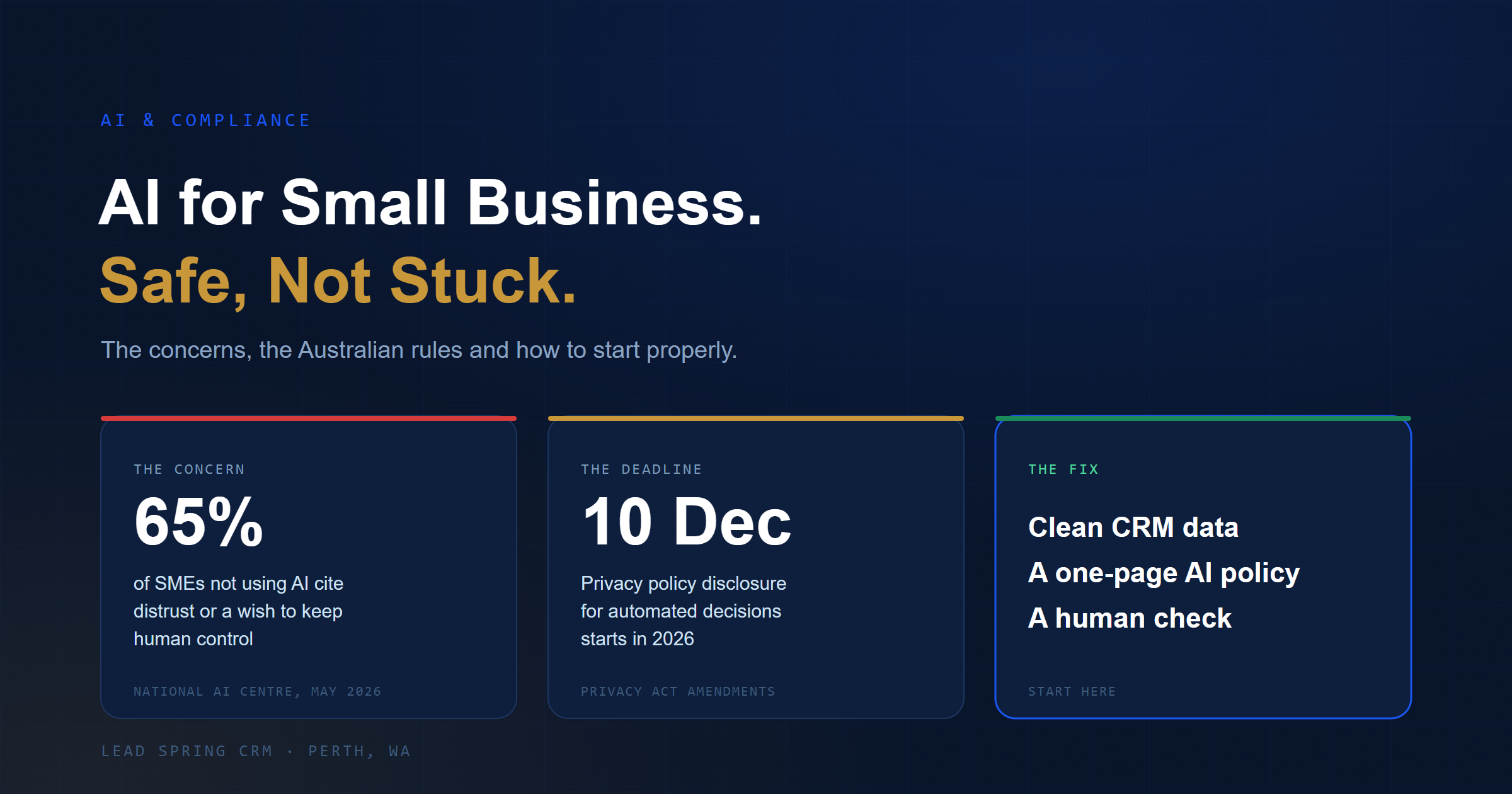
If you run a small business and you're cautious about AI, the data says you're in good company. Only 36% of Australians say they're willing to trust AI, and 78% are worried about negative outcomes (KPMG and the University of Melbourne, April 2025). Among Australian SMEs that haven't adopted it, about 65% cite distrust of AI decisions or a wish to keep human control (National AI Centre, May 2026). The barrier is trust, not cost.
I think that caution is sensible. But I also think the bigger risk now is drifting: doing nothing while competitors quietly answer enquiries in minutes and follow up every lead. This post covers what owners are worried about, what the rules actually are, and how to start safely. It isn't legal advice. If you have specific obligations, get proper advice.
How many Australian businesses actually use AI?
It depends on who's counting, and the numbers are very different.
- The Australian Bureau of Statistics found about 12% of Australian businesses used AI in 2024-25, up from 1% in 2021-22. That's about 11% of small and micro businesses. It's a strict measure, and it covers nearly 7,000 businesses.
- The National AI Centre's tracker counts any self-described use, and put SME adoption at 44% in February 2026.
Both can be true. Lots of owners have tried ChatGPT. Far fewer have built AI into how the business runs. And the gap is opening: the ABS found innovation-active small businesses adopt AI at 19%, almost five times the 4% rate of those that aren't innovating.
What owners are worried about
Trust and control. This is the dominant concern, and it's consistent across business sizes and locations.
Privacy and security. Security (29%) and budget (28%) were the top barriers in a 2025 survey of Australian businesses with 20 to 500 staff. The privacy regulator's advice is blunt: don't enter personal information, especially sensitive information, into publicly available AI chatbots.
Accuracy. AI produces confident answers that are wrong. McKinsey's 2025 global survey found inaccuracy was the most common negative consequence organisations actually experienced. Closer to home, Deloitte partially refunded the federal government over a A$440,000 report that contained fabricated references and a made-up court quote.
Skills and relevance. Around 54% of SMEs not using AI say it isn't relevant to them, and 19% say they don't know how to use it.
Rules. 77% of Australians think AI should be regulated, but only 30% think current safeguards are enough. Owners often aren't sure what applies to them.
Customers. 77% of Australians aren't sure whether online content can be trusted because it may be AI-generated. Customers notice, and they want to know a human is accountable.
What AI genuinely helps with
Among Australian SMEs using AI, 54% say it saves time and 34% say it improves productivity (MYOB, April 2026, a vendor survey). The most common uses are content creation and data analysis, at 54% each.
For a CRM, the practical gains are speed and consistency: a fast first reply to a web enquiry, a summary of a call, a suggested next step, a reminder so nobody slips through. That's where I'd start.
A word of caution on the headline numbers. Vendors report impressive figures, such as MYOB's finding that AI-using SMEs grow 2.8 times faster. That's a correlation. Businesses that adopt AI are often already more organised and growing. And the payoff is uneven: McKinsey found 88% of organisations use AI, but only 39% report any profit impact. The ones that do are the ones that attach AI to a specific workflow, rather than using it ad hoc.
The real risks
Projects that go nowhere. An MIT report claimed 95% of generative AI pilots show no measurable return. Treat that with caution, as it's preliminary and focused on large enterprises. But the lesson holds: AI without a clear job rarely pays off.
You own what your chatbot says. In Moffatt v Air Canada (2024), a Canadian tribunal held the airline liable for wrong advice its chatbot gave a customer. It's Canadian law, not Australian. But under the Australian Consumer Law, misleading statements are your statements, whoever or whatever wrote them.
Data leaks. Pasting customer details into a free chatbot can amount to disclosing personal information to a third party.
Poor data. AI in a CRM is only as good as the records underneath. Duplicates, stale contacts and missing consent records lead to wrong personalisation and, worse, marketing to people who never agreed to it.
Shadow AI. Staff using personal AI accounts for work is a common, invisible risk. 85% of Australian SMEs have no formal AI policy (MYOB, April 2026).
The rules in Australia
There's no AI Act. The National AI Plan (December 2025) confirmed the Government won't introduce mandatory guardrails for high-risk AI. Existing laws apply instead. The National AI Centre has published free voluntary guidance, including an AI policy template and an AI register. It's voluntary, but it's the benchmark a regulator is likely to use when judging whether a business acted reasonably.
Privacy Act. Three things matter:
- The privacy regulator can now issue infringement notices (currently up to $66,000 per contravention) for failures like not having a compliant privacy policy.
- From 10 December 2026, organisations covered by the Privacy Act that use personal information in automated decisions that could significantly affect someone's rights or interests must say so in their privacy policy. Think automated credit terms, eligibility or application screening, not drafting an email.
- Many businesses with turnover of $3 million or less aren't covered by the Privacy Act, with exceptions such as health service providers. You'll see claims online that this exemption ends on 10 December 2026. That's wrong, and the latest draft legislation doesn't remove it. Even so, following the Australian Privacy Principles is good practice, because customers and larger clients expect it.
Spam Act. This is the sharpest risk for CRM automation. You need consent to send commercial emails or SMS, you must be able to prove it, and every message needs a working unsubscribe. Recent penalties from the regulator, ACMA:
- SpinTel, $653,400 (November 2026), for emailing former customers, some who left up to 13 years earlier. ACMA said a previous business relationship did not automatically provide consent.
- Lululemon, $702,900 (March 2026), over order and delivery emails that carried marketing content with no unsubscribe. A "transactional" email with a promotional banner counts as a commercial message.
- Latitude Finance, $3.96 million (April 2026), including messages with no working unsubscribe.
Automation multiplies these mistakes at scale. One badly set up workflow can send thousands of non-compliant messages.
Australian Consumer Law. AI-generated marketing claims, chatbot answers and reviews all fall under the misleading and deceptive conduct rules.
A practical compliance checklist
- Write a one-page AI policy. Approved tools, what data must never go into them (customer details, health or financial information, passwords), who checks outputs, and who's accountable. The National AI Centre has a free template.
- Keep a simple AI register. Each tool, what it does, what data it touches, who owns it.
- Use business-grade tools. Pick plans that don't train on your data, and check the terms and where data is stored before connecting AI to your CRM.
- Update your privacy policy. Explain how you use AI with personal information, and describe any significant automated decisions before 10 December 2026.
- Keep a human in the loop. Review anything customer-facing, any figure or legal statement, and any decision about a person. Label chatbots and make a human easy to reach.
- Fix consent records in your CRM. Record how and when consent was given, honour unsubscribes everywhere, and don't let automation email former customers without clear consent.
- Review it every quarter. The tools, the laws and your staff's habits all change quickly.
How to stay competitive without taking silly risks
Most of the gain comes from doing the basics well, not from doing everything.
- Pick one bottleneck. Slow lead response, missed follow-ups, quoting, or repetitive admin. Don't start with "AI everywhere".
- Clean your CRM data first. De-duplicate contacts, fill key fields and record consent. AI amplifies whatever it sits on.
- Switch on AI in tools you already pay for. Most CRMs and email platforms now have built-in AI that's safer than copying data into a public chatbot.
- Automate the follow-up, review the first reply. Let AI draft, summarise and set tasks. Keep a person approving anything sent to a customer until you trust it.
- Measure one number. Time to first response, follow-up rate, or hours saved per week. If it hasn't moved in 90 days, change the approach.
- Put the guardrails in at the start. It's much easier than adding them later under pressure.
Where the CRM fits in
The CRM is where AI becomes useful for a small business, because it holds the customer history, consent records and pipeline that AI needs. On its own, AI produces generic content. Inside a well-run CRM, it can prioritise hot leads, personalise follow-up, flag stalled deals and keep marketing inside your consent rules.
The order matters: process and data first, automation second, AI third. None of this replaces your people. It takes repetitive admin off their desks so they can spend time where a human makes the difference.
If you're not sure whether your CRM data, consent records and automations are ready for AI, or you want your privacy policy and AI policy sorted before 10 December, that's what I do.
Book a Free CRM Chat and I'll check your setup and tell you what to fix first.
This post is general information, not legal advice. If you have specific obligations, such as health, finance or children's data, get legal advice.
Sources
- ABS, Characteristics of Australian Business 2024-25
- ABS media release: business adoption of AI accelerates
- National AI Centre, AI adoption insights, Dec 2025 to Feb 2026
- KPMG and University of Melbourne, Trust in AI 2025
- MYOB, AI-powered small businesses are growing 2.8x faster
- McKinsey, The State of AI in 2025
- OAIC, guidance on privacy and commercially available AI products
- ACMA, SpinTel penalty
- ACMA, Lululemon penalty
- CTV News (AP), Deloitte partial refund
- American Bar Association, Moffatt v Air Canada